
Associated Research project
Supported by the Hans und Berthold Finkelstein Stiftung
The research project, funded by the Hans and Berthold Finkelstein Foundation, aims to write a biography of the chemist Fritz ter Meer (1884–1967). It examines his role as a top executive at I.G. Farbenindustrie and Bayer AG within the political, societal, corporate, and scientific historical contexts of the 20th century. Where possible, the personal and family dimensions will also be included. The research is based on new collections of sources from state and corporate archives in Germany and abroad, as well as, for the first time, documents from the family’s private collection. As the son of Edmund ter Meer, founder of Chemische Werke vorm. Weiler-ter Meer, Fritz ter Meer grew up in Uerdingen in an upper-class family. After completing his studies in chemistry, he earned his doctorate under Nobel laureate Emil Fischer and joined his father’s company in 1910. In northern France, he oversaw the establishment of a branch of a tar dyestuff factory and returned to Uerdingen in 1913, where he became director and, in 1917, a member of the executive board. During World War I, he shifted production to support the war effort. When the family-owned company merged with other German chemical industry conglomerates in 1925 to form I.G. Farbenindustrie Aktiengesellschaft, the company appointed Fritz ter Meer to the executive board and, in 1930, to its highest governing body, the Central Committee. As chairman of the Technical Committee, ter Meer headed I.G. Farben’s central scientific and technological body since 1933. Stays abroad for several years in Great Britain, France (1910–1913), the United States (1926–1929), and Italy (1943–1945) enabled him to establish international connections with economic, political, and military elites. For the first time will examine his previously little-noticed activities in Italy from 1943 to 1945 on the staff of the General Commissioner of the Minister of Armaments and War Production. Three years after his arrest in Italy, he was charged as a war criminal in the 1948 Nuremberg IG Farben trial. Because of his responsibility for the exploitation of concentration camp prisoners at the IG Farben plant in Auschwitz and for the forced takeover of chemical companies in Poland and France under German occupation during World War II, the American military tribunal sentenced him to seven years in prison. After his early release from prison, he became a member of the supervisory board of Bayer AG and other West German companies until his resignation in 1964.
The study analyzes the margins of maneuver in which ter Meer operated as a manager – shaped by drastic breaks and long-lasting continuities – under changing political, economic, and military conditions in the German Empire, the Weimar Republic, the Nazi regime, and the Federal Republic.
Fritz ter Meer: Chemist and I.G. Farben Executive in an Age of Extremes
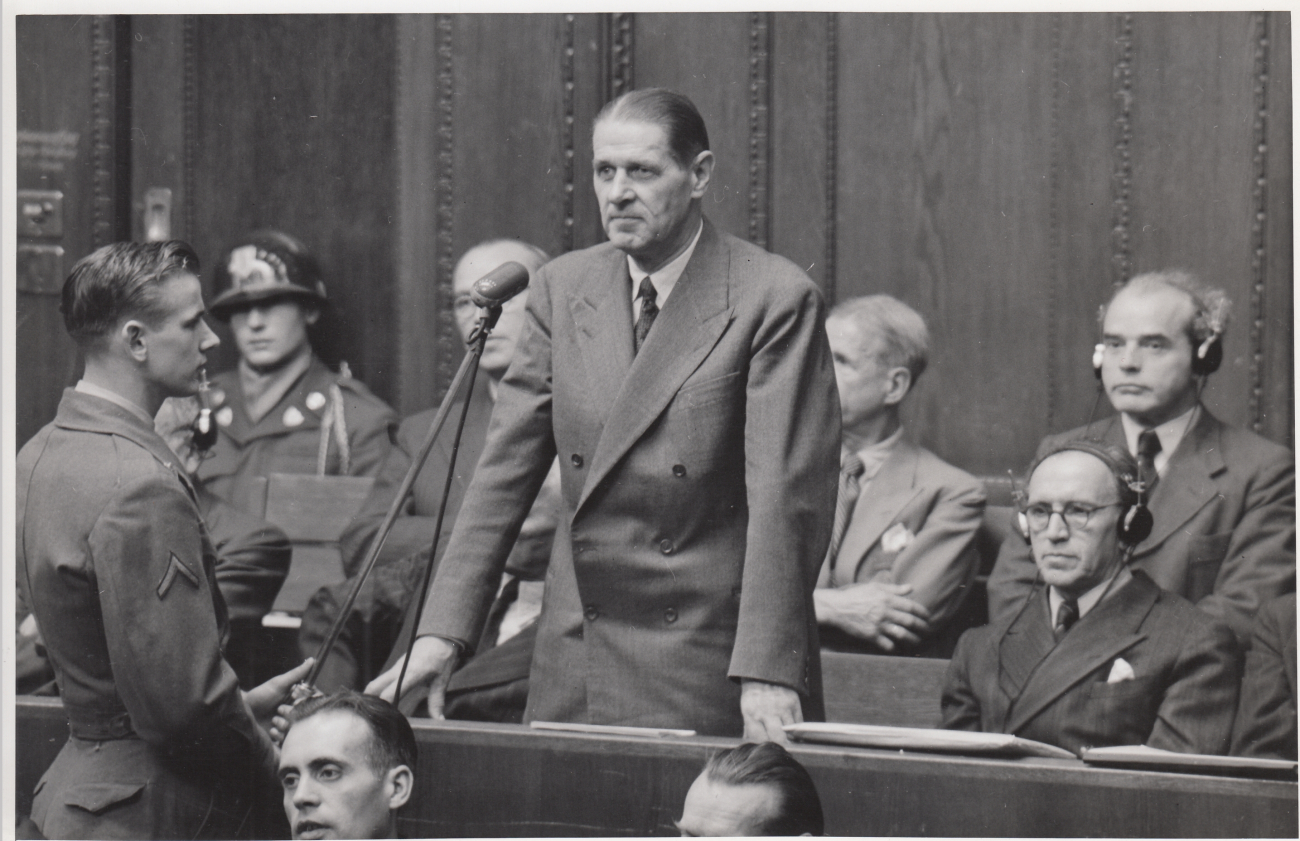
Bildinfo
Fritz ter Meer als Angeklagter Kriegsverbrecher im Nürnberger IG Farbenprozess 1947, Fotonachweis: National Archives, College Park, 238-OMT-VI-D-045_001)
Start of the project
August 2025


Bildinfo
Florian Schmaltz
Leibniz Centre for Contemporary History Potsdam ZZF
Am Neuen Markt 1
14467 Potsdam
Email: florian.schmaltz [at] zzf-potsdam.de
Am Neuen Markt 1
14467 Potsdam
Email: florian.schmaltz [at] zzf-potsdam.de