
Completed Joint project
Project leader: Frank Bösch
The project was funded by the Leibniz Association's ‘Innovative Projects’ fund.
The Leibniz Association funded four sub-projects. Additional sub-projects are associated with the ZZF.
Funded in line with a competition of the Leibniz Association
Duration: May 2014 - April 2017
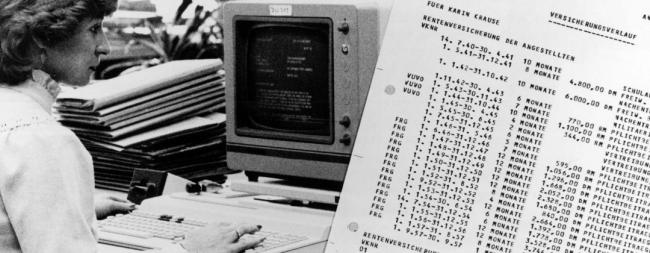
The rise of the computer age led to massive changes in society as early as the 1970s/1980s. Yet contemporary history has hardly dealt with these transformation processes. Only a few studies on the early history of West German computer technology do exist, predominantly in the fields of economic and technological history. For the GDR, they especially deal with the political control of production processes and information technology. The project seeked to explore the social significance of early computerisation in a pan-German perspective by analysing the social interpretations, practices and implications of the increased use of computers in both East and West Germany. By looking at the period between the 1960s and reunification, we examined an era in which computers were established in large administrations, businesses, and eventually with hackers and players, but before the Word Wide Web and the mass distribution of easy-to-use PCs initiated a new phase of computerisation in the early 1990s.
The social significance of computerisation would be explored, concentrating on three areas of research. First, we asked how it altered the world of labour, for instance with regard to processes, results or company structures. Second, we examined from the perspective of cultural and social history the ways in which computerisation shaped patterns of control and power, how it advanced centralised recording processes, new social observations, or even subversive networking. Third, we studied computerisation as a building block in the competition of the Cold War that has hardly been examined to date. The project addressed the asymmetrical interdependence between East and West Germany and compared the ways in which the respective political and economic settings shaped computerisation.
The project combined approaches of cultural and social history. All subprojects were empirically organised and based on an analysis of a variety of contemporary sources, such as archival documents from institutions and persons involved, digitally-produced sources, raw data of contemporary social history surveys on the world of labour, contemporary periodicals (e.g. labour unions and computer magazines), as well as qualitative surveys of witnesses. The project's results are already published as monographs and articles. The ZZF will be able to draw from its experience in the fields of German Contemporary History, the respective subsections, as well as the Contemporary History of Information Society.