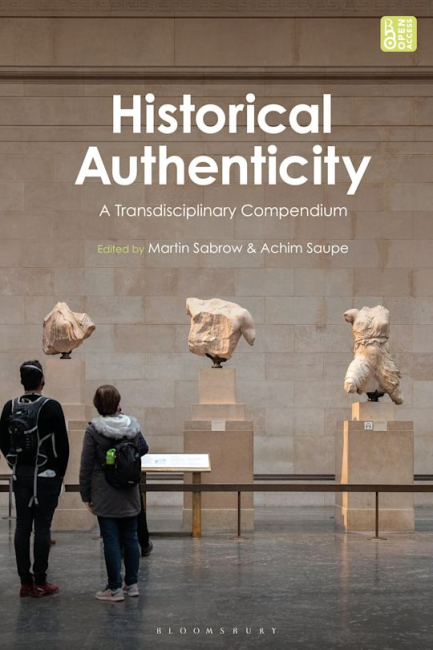
Authenticity has become a key concept in the culture of history and memory in the 21st century. This open access book explores the multifaceted nature of 'historical authenticity' and its uses in various academic, museum, and historical-cultural contexts. In 70 alphabetically-arranged articles, Historical Authenticity explains how authenticity can enable individuals and societies to locate themselves within time and space and the associated challenges.
The book shows how today's attitudes to the past are characterised by an intense striving for historical authenticity – a phenomenon which began to assume new potency in the last third of the 20th century. It considers how this manifests itself in practical terms, for example, in the value attached to 'authentic voices' from the past, 'authentic objects' in museums, collections and archives, or to 'authentic places' – be they historic buildings, urban architectural ensembles or memorial sites. The volume also reflects on how this desire for the 'real', the 'genuine' and the 'original' has changed over the centuries , and why it is nowadays so frequently linked with a longing to experience history 'first-hand', as evidenced in the degree of public attention accorded to surviving witnesses of historic events or the popularity of historical re-enactments. 'Historical Authenticity' convincingly makes the case that the analysis of academic, cultural, institutional and political authentification processes is central to a critical understanding of how the past is perceived in the present.
The book is edited by Martin Sabrow and Achim Saupe. It is a revised, updated and translated version of the "Handbuch Historische Authentizität" (Göttingen: Wallstein, 2022).
The ebook editions of this book are available open access under a CC BY-NC-ND 4.0 licence on bloomsburycollections.com. Open access was funded by the Leibniz Research Alliance Value of the Past
About the Editors:
Martin Sabrow is Spokesman and Achim Saupe is Head of the Leibniz Research Alliance “Value of the Past".