English version below
Presseinformation des ZZF Potsdam vom 03.08.2026
Jaromír Balcar erforscht seit dem 1. August 2026 am ZZF Potsdam die Geschichte bedeutender naturwissenschaftlicher Forschungseinrichtungen der Stadt in Zeiten politischer Zäsuren in der ersten Hälfte des 20. Jahrhunderts.
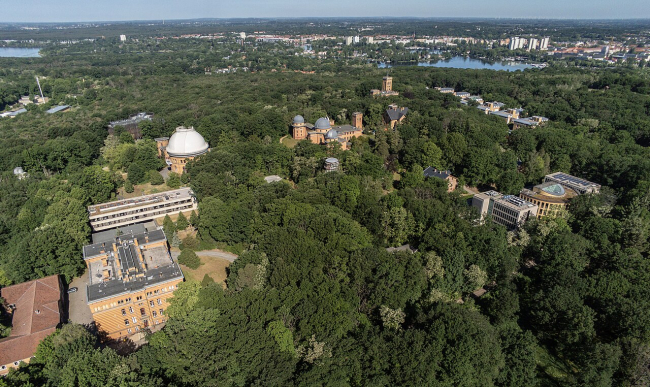
Unter dem Titel „Forschung im Spannungsfeld von Wissenschaft und Politik. Der Potsdamer Telegrafenberg und die Sternwarte Babelsberg 1930–1950“ geht der Historiker Jaromír Balcar am Leibniz-Zentrum für Zeithistorische Forschung Potsdam (ZZF) in den kommenden drei Jahren der Geschichte von weit über die Stadt hinaus bekannten naturwissenschaftlichen Einrichtungen auf den Grund. Dazu zählen das Geomagnetische Institut Potsdam mit dem Meteorologisch-Magnetischen Observatorium Potsdam, das Astrophysikalische Observatorium Potsdam und das Geodätische Institut Potsdam; hinzu kommt die Sternwarte Babelsberg, die 1913 aus Berlin verlegt worden war. Der Impuls zur Erforschung dieser bislang weitgehend unbekannten Vergangenheit kam von den heutigen vier Forschungseinrichtungen auf dem Telegrafenberg.
Der Fokus liegt auf dem zweifachen Umbruch von 1933 und 1945. Der gewählte Untersuchungszeitraum eröffnet eine doppelte Vergleichsperspektive: synchron zwischen den Forschungseinrichtungen, diachron zwischen der Endphase der Weimarer Republik, dem Nationalsozialismus und der Sowjetischen Besatzungszone (SBZ) bzw. der frühen DDR, wobei der Schwerpunkt auf der NS-Diktatur liegen wird. Über die beiden politischen Zäsuren hinweg sollen personelle, organisatorische und epistemologische Kontinuitäten und Brüche herausgearbeitet werden.
Inhaltlich konzentriert sich die Untersuchung auf drei Felder: Das erste behandelt die Institute und ihr Personal in der NS-Zeit. Dabei steht die Frage im Mittelpunkt, wie Politik und Ideologie Organisation und Inhalt der Forschung beeinflussten und wie sich die untersuchten Institute und ihr Personal an die damit verbundenen Herausforderungen anpassten. Das zweite Untersuchungsfeld beschäftigt sich mit dem Schicksal der Opfer der NS-Diktatur: Wer geriet in den Fokus der NS-Verfolgungsapparate, welche Verfolgungsgründe lassen sich dabei unterscheiden und wie wirkte sich dies auf die Biographien der Betroffenen aus? Das dritte Untersuchungsfeld beleuchtet die Nachkriegszeit, in der sich die Institute vor allem mit drei Problemen konfrontiert sahen: erstens einem eklatanten Mangel an Ressourcen, zweitens der forcierten Umgestaltungspolitik durch die Besatzungsmacht und drittens einem sich stetig verschärfenden Personalmangel. Zudem ist zu klären, wie man auf dem Telegrafenberg mit der NS-Vergangenheit und dem belasteten Personal umging.
Die Leitung des Projekts liegt bei Jutta Braun und Winfried Süß, Leiterin und Leiter der Abteilung „Regime des Sozialen“ am ZZF Potsdam. Es wird gefördert von der Nutzergemeinschaft Wissenschaftspark Albert Einstein, zu der das Leibniz-Institut für Astrophysik Potsdam (AIP), das Alfred-Wegener-Institut, Helmholtz-Zentrum für Polar- und Meeresforschung (AWI), das GFZ Helmholtz-Zentrum für Geoforschung und das Potsdam-Institut für Klimafolgenforschung (PIK) gehören. Die Projektlaufzeit beträgt drei Jahre.
Jaromír Balcar lehrt als Privatdozent Neuere und Neueste Geschichte an der Universität Bremen und hat mehrere Jahre im Forschungsprogramm zur Geschichte der Max-Planck-Gesellschaft mitgearbeitet. Er hat zahlreiche Publikationen zur Parteiengeschichte, zur Besatzungspolitik, zur Rolle der Finanzverwaltung bei der Judenverfolgung und zur Wissenschaftsgeschichte vorgelegt.
Für Interviewanfragen wenden Sie sich bitte an die Pressestelle des ZZF.
Mit Rückfragen zum Projekt wenden Sie sich bitte an:
Priv.-Dozent Dr. Jaromír Balcar
Leibniz-Zentrum für Zeithistorische Forschung Potsdam ZZF)
Am Neuen Markt 1
14467 Potsdam
e-mail: balcar [at] zzf-potsdam [dot] de
Telefon: 0331 28991-77
English version
Press release from the Leibniz Centre for Contemporary History Potsdam (ZZF) dated August 3, 2026
On 1 August 2026, Jaromír Balcar began conducting research at the ZZF in Potsdam into the history of the city’s major scientific research institutions during periods of political upheaval in the first half of the 20th century.
Jaromír Balcar’s research project is entitled, ‘Research at the Crossroads of Science and Politics: The Potsdam Telegrafenberg and the Babelsberg Observatory, 1930–1950’. He will be conducting research over the next three years at the Leibniz Centre for Contemporary History in Potsdam (ZZF) into the history of scientific institutions that were and are renowned far beyond the city’s borders. These include the Potsdam Geomagnetic Institute with the Potsdam Meteorological-Magnetic Observatory, the Potsdam Astrophysical Observatory and the Potsdam Geodetic Institute; in addition, there is the Babelsberg Observatory, which was relocated from Berlin in 1913. The four research institutions that are now located on the Telegrafenberg came up with the idea to investigate this hitherto largely unknown past.
Balcar’s project will focus on the twin upheavals of 1933 and 1945. This period of study opens up a dual comparative perspective: synchronic between the research institutions, and diachronic between the final phase of the Weimar Republic, the Nazi era and the Soviet Occupation Zone (SBZ) or the early GDR, with the emphasis on the Nazi dictatorship. Across these two political turning points, Balcar’s aim is to identify continuities and ruptures in terms of personnel, organisation and epistemology.
In terms of content, the study has three research foci. The first deals with the institutes and their staff during the Nazi era, focusing on the central question of how politics and ideology influenced the organisation and content of research, and how the institutes and their staff adapted to the challenges that arose in these contexts. The second research field concerns the fate of the victims of the Nazi dictatorship: who came under the scrutiny of the Nazi persecution apparatus, what different grounds for persecution can be identified, and how did this affect the lives of those affected? The third field examines the post-war period, during which the institutes were confronted primarily with three problems: firstly, a glaring lack of resources; secondly, the forced restructuring policies imposed by the occupying powers; and thirdly, an ever-worsening staff shortage. It will also be necessary to clarify how the Nazi past – and staff with a tainted past – were dealt with at the Telegrafenberg.
The project is led by Jutta Braun and Winfried Süß, Head and Deputy Head respectively of the ‘Regimes of the Social Sphere’ department at the ZZF in Potsdam. It is funded by the Albert Einstein Science Park Community, which comprises the Leibniz Institute for Astrophysics Potsdam (AIP), the Alfred Wegener Institute, the Helmholtz Centre for Polar and Marine Research (AWI), the GFZ Helmholtz Centre for Geosciences and the Potsdam Institute for Climate Impact Research (PIK). The project will run for three years.
Jaromír Balcar is a university lecturer in Modern and Contemporary History at the University of Bremen and has worked for several years on the Max Planck Society’s research programme on the history of the Society. He has published numerous works on the history of political parties, occupation policy, the role of the financial administration in the persecution of the Jews, and the history of science.
For interview requests, please contact the ZZF press office.
If you have any queries regarding the project, please contact:
Dr. Jaromír Balcar
Leibniz Centre for Contemporary History Potsdam (ZZF)
Am Neuen Markt 1
14467 Potsdam
e-mail: balcar [at] zzf-potsdam [dot] de (balcar[at]zzf-potsdam[dot]de)
Tel: 0331 2899177